
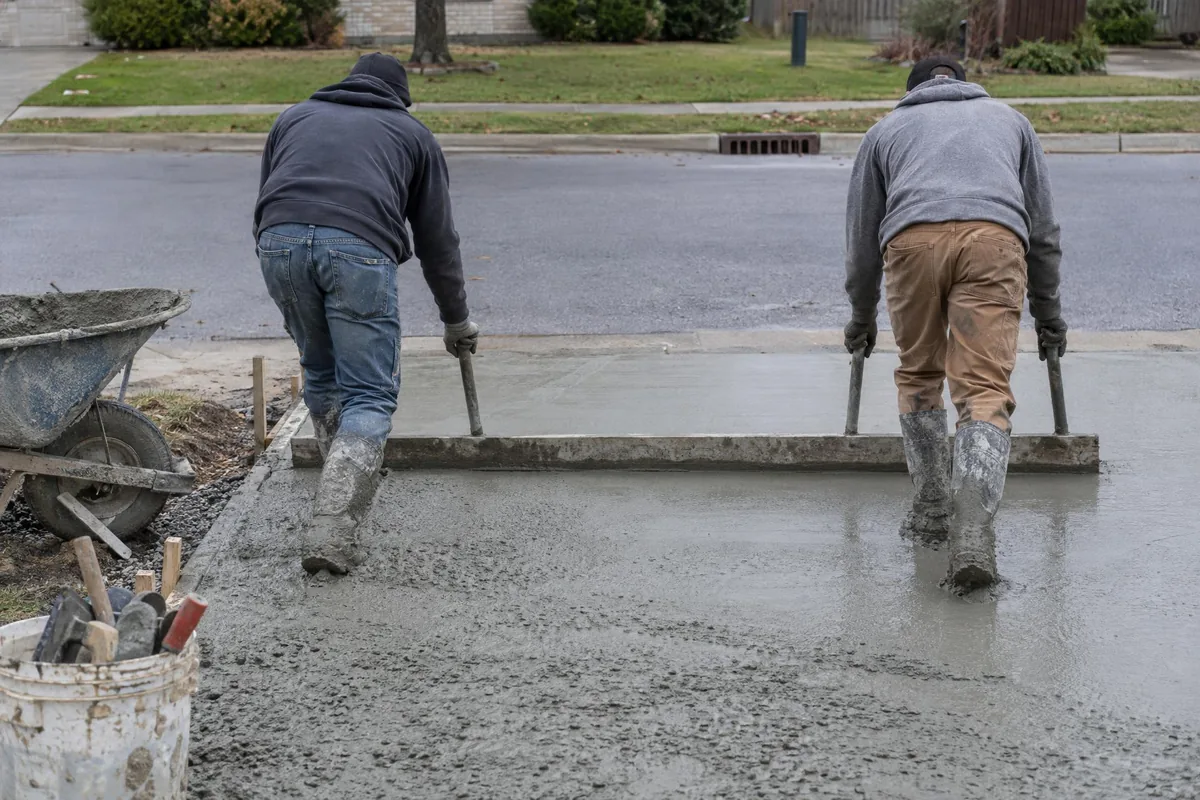
Two concrete workers in rubber boots pull a screed board across a wet slab beside a curb with a wheelbarrow nearby

Concrete Block Wall Hamilton New Jersey: Retaining Wall and Cinder Block Wall Construction

Dependable Concrete Block Wall and Retaining Wall Construction in Hamilton, NJ and Mercer County

When a slope is slipping, a yard needs privacy or a boundary needs marking, Hamilton Concrete builds the concrete block wall for Hamilton Township, NJ homeowners. We build the retaining wall, the garden wall and the cinder block wall on a poured footing, in Hamilton Square, Mercerville, Yardville and across Mercer County. You end up with a wall that holds its line through freezing winters instead of leaning a little more each spring.

Why homeowners choose us:

  • NJ-registered home improvement contractor
  • 20+ years pouring concrete across Mercer County
  • Permits handled we file the township application and schedule the inspections
  • Free written estimates with every line of the price broken out

The crew has 20+ years of concrete work in Mercer County, and every wall starts with the footing, because that is what keeps it standing. We confirm what the Township requires for a wall before we quote it. Your free written estimate itemizes the footing, the block, the reinforcement and the finish, so you can see where the cost sits.

Get a FREE Concrete Quote

What Concrete Block Wall Construction Involves in Hamilton, NJ

A block wall is only as good as what is below it and behind it, and the part you see is the last thing built. Every wall we build includes the steps below, whether it is a low garden wall or a retaining wall holding a slope:

  • Layout and grade fix the line, the height and the ground levels on each side, so the wall is built to hold what is actually there.
  • Excavation digs the trench for the footing to depth, which exposes firm ground for the concrete to bear on.
  • Footing is poured to depth and left to cure, and it is the base the whole wall rests on.
  • Block courses are laid level and plumb, with mortar joints tooled to shed water.
  • Reinforcement runs steel through the cores where the wall needs it, which ties the courses together.
  • Fill and grout go into the cores that carry load, so the wall acts as one piece.
  • Drainage is built behind a retaining wall, so water leaves instead of pushing on the block.
  • Finish is a coating or cap that suits the house, and it keeps water out of the top of the wall.

Signs You Need a New Block Wall in Hamilton

When a Hamilton Wall Needs Rebuilding

  • A wall that leans has lost its footing or its drainage, and the lean grows each time the ground freezes.
  • Horizontal cracks in the block mean the wall is being pushed from behind, and they point to water pressure.
  • Stair-step cracks in the mortar show a corner or section settling, which means the footing under it has moved.
  • Water stains and bulges show that drainage is failing and the soil behind is holding water.
  • A yard that needs a level area gains it from a retaining wall that steps the slope.

Why Block Walls Are Harder in Hamilton Winters

Frost and the Footing

Mercer County towns set residential deck footings at least 36 inches deep for frost protection, and a wall footing follows the same logic. A footing above the frost line heaves when the ground freezes, and a wall on it cracks or tilts. A wall is long, so one heaved section breaks the line and cracks the courses above it. Lawrence Township asks for footings 12 inches below grade for midsize structures and 36 inches for larger ones, which shows how depth scales with size.

Water Behind the Wall

Hamilton Square gets about 47.5 inches of rain and 23.9 inches of snow a year. Water that collects behind a wall freezes and expands, and that pushes on the block. Block is porous, so water behind the wall also moves through the face and shows up as stains. Effective drainage that carries water away slows frost damage, so a retaining wall gets drainage built in behind it, not added later. Gravel and a drain pipe behind the wall give the water somewhere to go before it freezes against the block, and that is the cheapest protection a retaining wall can have.

Salt at the Base

January nights average 23.7°F and February nights 25.1°F, so a wall by a driveway or sidewalk sees salt spray and meltwater all winter. Snow piled against its base freezes to the block, and plow and shovel add to the wear. Scaling is physical salt attack. High-strength, air-entrained concrete resists it, and calcium chloride is gentler on concrete than rock salt.

How Much Does a Concrete Block Wall Cost in Hamilton, NJ?

Block wall cost in Hamilton depends on the wall, not on a flat rate, because a low garden wall and a tall retaining wall are very different builds. The length and the height, the depth of the footing, the reinforcement, the drainage behind the wall and the finish all move the price. Height drives cost faster than length, since taller walls need deeper footings and more steel. Your written estimate lists the footing, block, reinforcement, drainage and finish on separate lines.

Our Concrete Block Wall Process in Hamilton, NJ

Four stages take a wall from a staked line to a finished face.

1. Line and Grade Check

Two stakes and a string line mark the wall at the visit, and a level reads the ground. We stake the wall, read the ground on both sides and decide how much it has to hold. The free written estimate that follows names the footing depth, the reinforcement and the drainage, and we confirm what the Township requires for the wall before the quote is final.

2. Trench and Footing

The trench is dug to depth and cleaned of loose soil so the concrete bears on firm ground. The footing is then formed, reinforced and poured. The footing is left to cure before any block goes on it, because a wall built on green concrete settles. We do not pour in freezing weather, since Hamilton requires frozen concrete without approved protection to be removed.

3. Block, Steel and Fill

Block courses go up level and plumb, with steel run through the cores and grout poured where the wall needs it. Each course is checked with a level before the next goes on, so errors do not stack up. Drainage is set behind a retaining wall as it rises. The mortar joints are tooled as the courses go up, so they shed water instead of holding it.

4. Finish, Cap and Backfill

The wall is capped and finished, and backfill goes in behind it in layers. Drain outlets are kept clear, and the wall is checked for plumb before the crew leaves. Full strength on the poured footing comes at 28 days, and we hold heavy loads off the wall until then. See our concrete footings and concrete slabs pages for related work.

Concrete Block Walls FAQs: Hamilton, NJ

How much does a concrete block wall cost in Hamilton, NJ?

Block wall cost depends on length, height, footing depth, reinforcement, drainage and finish. Height drives the price faster than length, and each item is its own line on the written estimate.

How deep does a block wall footing need to go in Mercer County?

Mercer County towns set residential deck footings at least 36 inches deep for frost protection, and a wall footing follows the same logic. We confirm the depth for your wall before we quote.

What is the difference between a cinder block wall and a concrete block wall?

Both words describe a wall of hollow masonry block. Today's block is concrete, and the wall is reinforced and grouted where it carries load.

Why is my retaining wall leaning?

A leaning wall has lost its footing or its drainage. Water behind it freezes and pushes on the block, and a footing above the frost line heaves.

Does a retaining wall need drainage?

Effective drainage that carries water away slows frost damage. A retaining wall gets drainage behind it so water leaves instead of building up against the block.

Can a leaning block wall be repaired?

A wall with a sound footing and minor cracks can be repaired. A wall that leans, bulges or has stepped cracks usually needs rebuilding on a new footing.

Can you build a wall in winter in Hamilton?

Hamilton requires concrete exposed to a freeze without approved protection to be removed and replaced, so footings are poured on days that stay above freezing.

Hamilton Concrete serves Hamilton and Mercer County.

Get a Free Concrete Block Walls Quote in Hamilton, NJ

(609) 307-2735 Get a Free Quote