
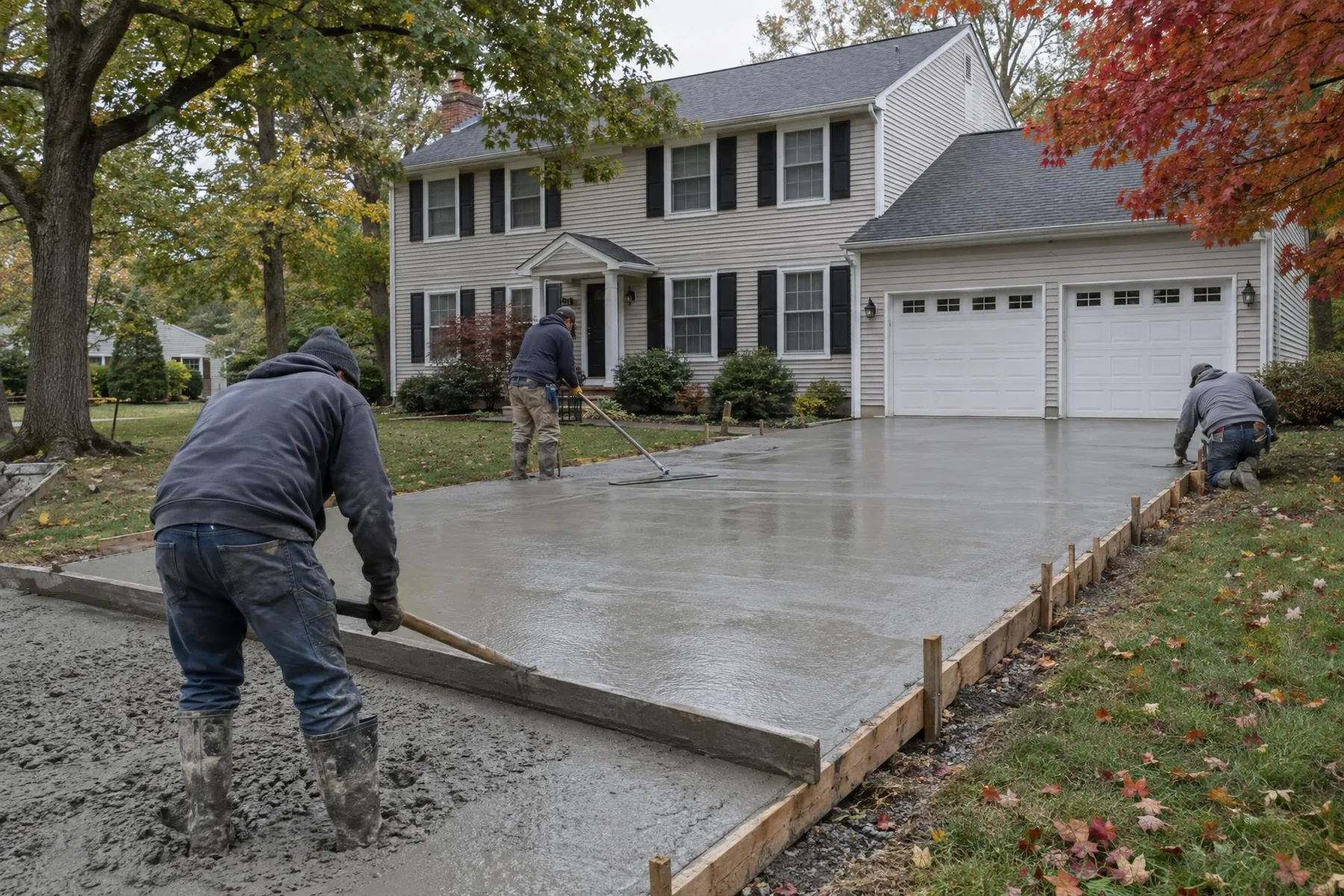
Two workers screed and finish a freshly poured concrete driveway in front of a two-car garage colonial home

Concrete Driveway Hamilton New Jersey: Concrete Driveway Installation and Replacement

Reliable Concrete Driveway Installation and Driveway Replacement in Hamilton, NJ and Mercer County

If your driveway is cracked, sunken or still gravel, Hamilton Concrete pours a new concrete driveway for homeowners in Hamilton Township, NJ, and across Mercer County. We handle concrete driveway installation, concrete driveway replacement, widening and the apron at the street. You end up with a driveway that drains toward the road, meets the Township's rules and passes its inspection, whether the house is in Hamilton Square, Mercerville or Yardville.

Why homeowners choose us:

  • NJ-registered home improvement contractor
  • 20+ years pouring concrete across Mercer County
  • Permits handled we file the township application and schedule the inspections
  • Free written estimates with every line of the price broken out

Our crew has 20+ years of concrete work in Mercer County, and every driveway job includes the permit application and the inspection calls. We order the 4,000 psi mix Hamilton requires, delivered by truck from an NJ State-certified company, and pour it over a compacted stone base. You get a free written estimate that prices the tear-out, the base, the concrete and the finish on separate lines.

Get a FREE Concrete Quote

What Concrete Driveway Installation Involves in Hamilton, NJ

Every Hamilton driveway job runs in a fixed order, and a Township inspector checks the forms before any concrete goes in. Every driveway we pour includes the steps below, whether it is a first pour, a replacement or a gravel driveway being converted:

  • Permit and layout come first, with the width, the setback and the apron marked and the application filed, so nothing is dug before the Township has the plan.
  • Tear-out breaks up the old slab or clears the gravel and hauls it off, which leaves clean ground for the new base.
  • Stone base is graded and compacted under the slab, and it is the layer that keeps the driveway from settling after the first wet winter.
  • Forms set the edges, the thickness and the pitch toward the street, and they stay in place until the inspector has signed off.
  • Reinforcement goes in as wire mesh or rebar on heavier loads, and it keeps a crack tight instead of letting it open.
  • The pour uses 4,000 psi concrete placed in one pass, so the slab has no cold joints where water could get in.
  • Finish is a broom texture for grip on wet and icy days, or a stamped or colored surface when you want something other than gray.
  • Control joints are sawn in on a layout, which steers shrinkage cracks into straight, tight lines.

Signs You Need a New Concrete Driveway in Hamilton

When Hamilton Driveway Concrete Has Reached the End

  • Flaking and pitting means salt and freezing have worn the top layer away, and each winter takes more of it until the surface is rough and thin.
  • Cracks wider than a pencil line let meltwater under the slab, where it freezes and lifts the concrete, and a crack that has stepped means the base underneath has moved.
  • A slab that has dropped or tilted toward the garage has lost the stone under it, and the water then runs the wrong way.
  • A driveway under 4 inches thick is below the Township minimum, so a thin slab left by an earlier contractor will keep cracking.
  • Gravel or loose stone is not permitted as a driveway surface in Hamilton, so a gravel driveway has to be rebuilt in concrete.

Hamilton Township Driveway Rules and Winter Damage

What the Township Requires

A new driveway needs a permit, and so does resurfacing one, while sealing needs none. The fee is $30 per permit, one permit for each address, and it is valid for a year. Concrete has to be at least 4 inches thick, with 6 inches recommended, and it has to be 4,000 psi. A plot plan is needed only when the driveway is being widened.

Width, Setback and Apron

A standard driveway is 10 feet wide and none can exceed 20 feet. The driveway has to sit 5 feet off the property line, and an older driveway closer than that is grandfathered. Widening within 5 feet needs a waiver from the Land Use Office. The driveway apron and the sidewalk in front of it must be 6 inches thick, and the owner keeps them in repair. Overlays over an old slab have to be keyed in 12 inches at both ends.

Inspections, Salt and Freezing

The Township inspects the forms before the pour and re-inspects automatically afterward, and it asks for 48 hours’ notice through the Call Center at 609-586-0311. Nobody has to be home for an inspection, and the inspector leaves a note if something fails. Hamilton Square gets 47.5 inches of rain and 23.9 inches of snow a year, and salt attacks a slab’s surface through repeated freezing. Air-entrained concrete at 4,000 psi, good drainage under the slab and calcium chloride instead of rock salt all slow that damage.

How Much Does a Concrete Driveway Cost in Hamilton, NJ?

A plain broom-finished concrete driveway in Hamilton costs about $8 to $15 per square foot, and tearing out the old slab first adds roughly $1 per square foot. Stamped finishes cost more, and the stamped concrete page covers that range. Where a job lands depends on the thickness, the digging and base work the lot needs, how much old concrete or gravel comes out, whether the slab is reinforced and the finish. Each of those appears as its own line on your written estimate.

Our Concrete Driveway Process in Hamilton, NJ

Four steps take a driveway from the first visit to the first car parked on it.

1. Visit and Estimate

We measure the driveway and look at the old slab, the ground under it and the way water leaves the lot. The free written estimate that follows lists the tear-out, base, concrete and finish line by line. Once you approve it, we file the Township permit, with a plot plan if the driveway is being widened.

2. Tear-Out and Base

Crews break out the old driveway and haul it away, then grade the ground and compact a crushed stone base over it. Concrete poured on loose ground settles and cracks within a few seasons, so the base is finished first and the forms go in afterward. Thick slabs with rebar in them take longer to break up, and that is the part of the job that varies most from one house to the next.

3. Forms, Inspection and Pour

Two inspections frame the pour, one of the forms before it and one of the slab after it. The forms go in with the pitch and the thickness, and we call the Township 24 hours before we pour the apron. We do not pour when freezing is expected, because Hamilton requires concrete exposed to a freeze without approved protection to be removed and replaced.

4. Cure and First Use

Foot traffic is fine at 24 to 48 hours, a passenger car at about 7 days and heavy vehicles once the slab reaches full strength at 28 days. Keep the edges clear longer, since they cure last, and hold off on de-icing salt through the first winter.

The same crew also pours concrete patios and stamped concrete.

Concrete Driveways FAQs: Hamilton, NJ

How much does a concrete driveway cost in Hamilton, NJ?

A plain concrete driveway in Hamilton costs about $8 to $15 per square foot, and removing an old slab adds roughly $1 per square foot. Thickness, base work, reinforcement and finish move the price within that range.

Do I need a permit for a new concrete driveway in Hamilton Township?

A new driveway needs a permit, and so does resurfacing one. The fee is $30 per permit, one permit per address, valid for one year. Sealing an existing driveway needs no permit.

How thick does a concrete driveway have to be in Hamilton?

Hamilton requires at least 4 inches, and 6 inches is recommended. The apron and sidewalk in front of the driveway must be 6 inches thick. The concrete has to be 4,000 psi, delivered by truck from an NJ State-certified company.

How wide can a driveway be in Hamilton Township?

A standard driveway is 10 feet wide and a shared driveway is 20 feet wide. No driveway can be wider than 20 feet. Widening needs a plot plan, and the driveway has to stay 5 feet from the property line unless the Land Use Office grants a waiver.

How long before I can drive on a new concrete driveway?

Foot traffic is fine after 24 to 48 hours and a passenger car after about 7 days. Heavy vehicles such as RVs and large trucks should wait for full strength at 28 days.

Can I keep a gravel driveway in Hamilton Township?

Hamilton permits concrete, blacktop, and brick pavers or Belgian block. Stone or gravel driveways are not permitted, so a gravel driveway is converted to a permitted surface when it is rebuilt.

Should I repair or replace my concrete driveway?

Repair works when the slab is level and solid and the damage is on the surface, such as narrow cracks and light flaking. Replacement is the right call when the slab has sunk, the cracks have stepped or the concrete is crumbling through its depth.

Who is responsible for the driveway apron and sidewalk in Hamilton?

The owner of the property carries this responsibility in Hamilton, and has to keep the area between the property line and the street line in good repair, including the sidewalk, apron and curb. The street line is the edge of the paved surface.

Hamilton Concrete serves Hamilton and Mercer County.

Get a Free Concrete Driveways Quote in Hamilton, NJ

(609) 307-2735 Get a Free Quote